


1.2 V Battery checker by discharge
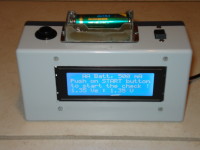
This project was inspired by the Martin OSSMANN battery checker. I found it can be enhanced and simplified. My scheme shows these improvements. It works fine now !
This project was inspired by the Martin OSSMANN battery checker. I found it can be enhanced and simplified. My scheme shows these improvements:
1 - The ATMega328 is programmed by means of Arduino : this makes me easier for programming.
2 - I use a 4 x 20 char LCD display: The Ossmann displays are for Elektor readers and specialists ! My displays are for friends and family who are not familiar with these purposes.
3 - I add a "START" button, so the user follows the operation.
4 - The LCD circuit is simpler (no negative voltage generation).
5 - I add a resistor (pull-down) to detect when the battery is removed from the socket (10 kOhm).
6 - The time counter uses the Timer 1 (ISP socket is available for, programming the ATMega328).
7 - The discharge current is selected by a switch depending on the battery size (AA or AAA size) : 50 mA or 20 mA. The switch position must match with battery size, else the check will not start. Very easy to use !
8 - I write the program using ARDUINO language, not ATMEL Studio. It is very simple to read and understand.
The other parts of the scheme are not modified significantly. The program works correctly. The program counts (Timer1) the discharge duration; during this time, the current in the FET is regulated to drain 20 mA (AAA battery), or 50 mA (AA battery) by Timer2 used as PWM generator.
Buildt it and post here your battery load results, or send an email !
All ideas and suggestions are welcome !
2021/01/08
I add a table showing the caacity of my batteries. Because someone are very old, I didn't mention the brand. It seems the capacity depends on the loading mode, on the 2nd battery during loading, . . . .
2021/01/08
I add a table showing the caacity of my batteries. Because someone are very old, I didn't mention the brand. It seems the capacity depends on the loading mode, on the 2nd battery during loading, . . . .
Want to build a project?
Bring your design to life with the Elektor PCB Service, powered by Eurocircuits. Upload the project files and order professionally manufactured PCBs or assembled boards through a proven European production platform.
Supporting KiCad, Eagle, Gerber, and ODB++ formats, the service is suitable for everything from prototypes and validation builds to series production and volume manufacturing.
Made in Europe. Fast. Reliable. Professional.
Discussion (2 commentaire(s))