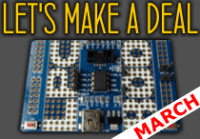
During March 2014, all members posting projects in Elektor.LABS will receive an LPC800 Mini-Kit for free. Simply log-in first, and then create a project or enter a proposal, and the Elektor.LABS team will contact you at the end of the month. Easy ;) This awesome board will be delivered to your mailbox completely for free!
About the LPC800 Mini-Kit
The NXP LPC800 Mini-Kit comes with an LPC810 microcontroller unit (MCU) in an 8-pin DIP package. The LPC810 MCU features 4 KB of flash memory, 1 KB of SRAM and peripherals like two USARTs, an I²C port, an analog comparator, timers and much more.
The LPC800 Mini-Kit is a small break-out board sporting – besides of course the LPC810 – a 3.3 V power supply, two prototyping areas, one user LED, two push-buttons, an Serial Wire Debug (SWD) connector and a serial port that doubles as an In-System Programming (ISP) port. The Mini-Kit is powered from 5 V through its on-board mini USB connector.
The board can be programmed and debugged with any SWD compatible programmer/debugger (like NXP’s LPC-Link) directly from within NXP's free LPCXpresso IDE. An ISP port to program the MCU is available for those who do not possess an SWD pod. All you need is a serial port and the free tool Flash Magic. The ISP connector is compatible with the well-known 3V3 serial-to-USB cable from FTDI.
Veuillez saisir votre adresse électronique. Les instructions de réinitialisation de votre mot de passe vous seront immédiatement envoyées par courriel.
Elektor Magazine est depuis 65 ans l’une des principales sources d’information en électronique pour les ingénieurs, les concepteurs, les start-ups et les entreprises. Notre magazine est soutenu par une communauté active d’ingénieurs en électronique – des étudiants aux professionnels – passionnés par la conception et le partage d’idées innovantes.
Pour eux, nous publions chaque année des centaines de contenus sous différents formats, tels que des articles, des vidéos, des webinaires et d’autres formats d’apprentissage. Notre mission est de partager les connaissances de toutes les manières possibles et d’inspirer les lecteurs avec les dernières évolutions du secteur de l’ingénierie électrique.
Thank you for your vote!
Ajoutez vos commentaires
Thank you for your vote!
Veuillez vous connecter pour ajouter une note ou fermez pour revenir en arrière
Discussion (0 commentaire(s))