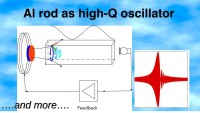
A surprising inductive eddy current couping of electrical signals into vibration of mechanical resonantors are explored. As an educational fun project an aluminum rod from a hardware store was converted to a high-Q factor oscillator that can be made oscillating in a number of different vibrational modes and frequencies.
Large Q mechancal oscillators are abundant in electronic circuits old and new, namely in the form of quartz crystal resonators, cearmic IF filters, SAW-filters etc.. In the acoustic real we have a plethora of vibrating structures in the audible range: strings, drums, xylophones, gongs, bells, triangles and finally tuning forks. These typically are excited by mechanical kicks. Tuning forks were also used as frequency determining element in watch-clock oscillators. The frequency of strings and drum membranes depend of tension, while those off xylophones, bells ... depend on shape and elasticity properties, also does their spectrum of oscillation deviate from a smple sequence of integer multiples of the fundamental frequency.
If you ever went to a hardware store and bought a plain not to short metal rod, e.g. from aluminium, you may have made the observation that kicking then end produces a high pitched tone that may linger for many seconds –if you hold the rod at the right position, i.e. at he center, only. A sign that such a rod may serve as hands on model of a very high-Q mechanical oscillator allowing for exploration of various properties of these type of oscillators, role of oscillation mode spectra, measure (educational) the elasticity constant of the rod material and explore a surprsing method to completely contact free coupling the electronic frequency signal to the (Al)-structure.
Here some experiments with a mechanical oscillator consisting of a freely susbended 1m long Al- rod with and without electronic feedback are presented.
Want to build a project?
Bring your design to life with the Elektor PCB Service, powered by Eurocircuits. Upload the project files and order professionally manufactured PCBs or assembled boards through a proven European production platform.
Supporting KiCad, Eagle, Gerber, and ODB++ formats, the service is suitable for everything from prototypes and validation builds to series production and volume manufacturing.
Veuillez saisir votre adresse électronique. Les instructions de réinitialisation de votre mot de passe vous seront immédiatement envoyées par courriel.



Discussion (3 commentaire(s))