


Compensate the distortion of a Nonlinear System
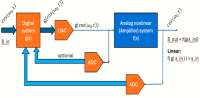
Methods to find system's distortion-generating function, f(x). Determine the inverse distortion function g(x). And create an overall linear system. For the slides about the content, have a look in the attached pdf !!
Traditionally, the distortion of a system is measured by analyzing the harmonics produced by the nonlinear system under test. Metrics such as Spurious Free Dynamic Range (SFDR) and other similar figures (SFDR and THD) are derived from these measurements. However, these metrics do not provide a visual representation of the system's distortion-generating function, f(x).
In this presentation, I will first demonstrate a method to extract and compute the function f(x) from the measured harmonics by driving the system with a fixed tone ω_0. This approach aligns with the traditional method of measuring distortion in a nonlinear system through harmonics.
Next, I will introduce a more direct method that can accurately determine the shape of the distortion function f(x). This method allows for the use of a wider range of input signals and enables the determination of f(x) on a running system. For example, it becomes possible to find the distortion function f(x) of an audio amplifier while it is playing music, rather than using a monotonous test tone.
Once the distortion function f(x) is known, we can explore how to utilize this knowledge. Specifically, it is possible to determine an inverse distortion function g(x), which can then be used to linearize the overall system. By applying g(x) such that the output signal equals the input signal, the overall system can achieve linear performance.
TODO, Not shown yet:
TODO, Not shown yet:
To demonstrate the improvements in distortion, I will compute and plot the distortion metrics (such as SFDR and THD) for different amplitude levels of a cosine input signal. I will do this for the system characterized by f(x) and then for the system characterized by g(f(x)). This will clearly show the reduction in distortion when the inverse distortion function is applied.
For the slides about the content, have a look in the attached pdf !!
Want to build a project?
Bring your design to life with the Elektor PCB Service, powered by Eurocircuits. Upload the project files and order professionally manufactured PCBs or assembled boards through a proven European production platform.
Supporting KiCad, Eagle, Gerber, and ODB++ formats, the service is suitable for everything from prototypes and validation builds to series production and volume manufacturing.
Made in Europe. Fast. Reliable. Professional.
Discussion (2 commentaire(s))