This idea was triggered by a ready-made project we received. It contained an XBee module which was used in transparent mode (in short: UART to XBee), connected to the PC via a good old RS232 interface. I was lucky to have a PC with one COM port, but I decided to make a small PCB to connect it to USB using a FTDI-cable.
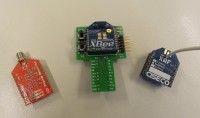
This idea was triggered by a ready-made project we received. It contained an XBee module which was used in transparent mode (in short: UART to XBee), connected to the PC via a good old RS232 interface. I was lucky to have a PC with one COM port, but I decided to make a small PCB to connect it to USB using a FTDI-cable. XBee modules have 2mm pitch pinheaders for connection to the outside world, and they don’t match any existing breadboard or prototyping board, so a breakout board with standard .1” pinheaders was a quite nice, though not very original idea. At that time we just started selling the microcontroller T-Boards designed by Andrew Retallack, and the response from our readers to the boards was encouraging enough to think about more T-shaped PCB’s to be used in combination with breadboards. So, why not a T-board for XBee modules? Not only are the 20 pins of the XBee routed to two standard .1” pitch pinheaders, its UART pins are connected to a 6-pin header for a 3.3V FTDI-cable. Xbee modules are 3.3V devices, and their I/O pins are not 5V tolerant! Even a 3.3V FTDI-cable has a 5V supply voltage on its VDD pin, so to power the T-Board via USB a 3.3V voltage regulator (IC1) is needed. To make the board even more suitable for prototyping two push buttons (Reset and Commissioning) and two LED’s (RSSI and status indication) were added. At a later stage I realized that this T-board is also suited for other wireless modules than XBee only. For that reason I decided to even route the two NC (Not Connected) pins to the bread board connections (just in case). Ciseco makes XRF-boards, Microchip (formerly Roving Networks) makes WiFi and Bluetooth modules with the same footprint and even matching pin assignment for the most vital functions. And maybe I missed other modules from other manufacturers that can also be made bread board-ready using this T-Board.
Want to build a project?
Bring your design to life with the Elektor PCB Service, powered by Eurocircuits. Upload the project files and order professionally manufactured PCBs or assembled boards through a proven European production platform.
Supporting KiCad, Eagle, Gerber, and ODB++ formats, the service is suitable for everything from prototypes and validation builds to series production and volume manufacturing.
Veuillez saisir votre adresse électronique. Les instructions de réinitialisation de votre mot de passe vous seront immédiatement envoyées par courriel.
Elektor Magazine est depuis 65 ans l’une des principales sources d’information en électronique pour les ingénieurs, les concepteurs, les start-ups et les entreprises. Notre magazine est soutenu par une communauté active d’ingénieurs en électronique – des étudiants aux professionnels – passionnés par la conception et le partage d’idées innovantes.
Pour eux, nous publions chaque année des centaines de contenus sous différents formats, tels que des articles, des vidéos, des webinaires et d’autres formats d’apprentissage. Notre mission est de partager les connaissances de toutes les manières possibles et d’inspirer les lecteurs avec les dernières évolutions du secteur de l’ingénierie électrique.
Thank you for your vote!
Ajoutez vos commentaires
Thank you for your vote!
Veuillez vous connecter pour ajouter une note ou fermez pour revenir en arrière



Discussion (0 commentaire(s))