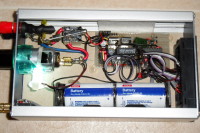
My idea started when I whould like to use my cool box at home, but the built-in thermostat had a fixed switching-point. I had a thermostat module laying around; it has two switching points and two outputs, one for the lower level, one for the higher, both individually adjustable. So, hysteresis is adjustable too.
My idea started when I whould like to use my cool box at home, but the built-in thermostat had a fixed switching-point. I had a thermostat module laying around; it has two switching points and two outputs, one for the lower level, one for the higher, both individually adjustable. So, hysteresis is adjustable too. I took a bistable relay with two coils (laying around of course, like the most parts of this project), and used a CMOS 4538 monostable multivibrator to generate the switching pulses for that relay. Working fine when it´s running... but when power is switched off, we have to consider the following points: 1. The battery of the module will discharge through the inputs of the 4538. 2. When powering on again, the state of the bistable relay is unknown, the switching pulse has to be repeated. C2/R2 and C5/R5 prevent the 4538 to generate an impulse when powering on, next, after a delay generated by C3/R7, T1 switches on the reed relay RE1 and the 4538 may generate an impulse to switch the power relay RE2 on or off. Now it´s ready and working (except for three buttons for the module), and I think, why I didn´t use a microcontroller? Hmm, I whould program more functions than necessary. Now it´s programmed in true hardware language!
Veuillez saisir votre adresse électronique. Les instructions de réinitialisation de votre mot de passe vous seront immédiatement envoyées par courriel.
Elektor Magazine est depuis 65 ans l’une des principales sources d’information en électronique pour les ingénieurs, les concepteurs, les start-ups et les entreprises. Notre magazine est soutenu par une communauté active d’ingénieurs en électronique – des étudiants aux professionnels – passionnés par la conception et le partage d’idées innovantes.
Pour eux, nous publions chaque année des centaines de contenus sous différents formats, tels que des articles, des vidéos, des webinaires et d’autres formats d’apprentissage. Notre mission est de partager les connaissances de toutes les manières possibles et d’inspirer les lecteurs avec les dernières évolutions du secteur de l’ingénierie électrique.
Thank you for your vote!
Ajoutez vos commentaires
Thank you for your vote!
Veuillez vous connecter pour ajouter une note ou fermez pour revenir en arrière
Discussion (0 commentaire(s))